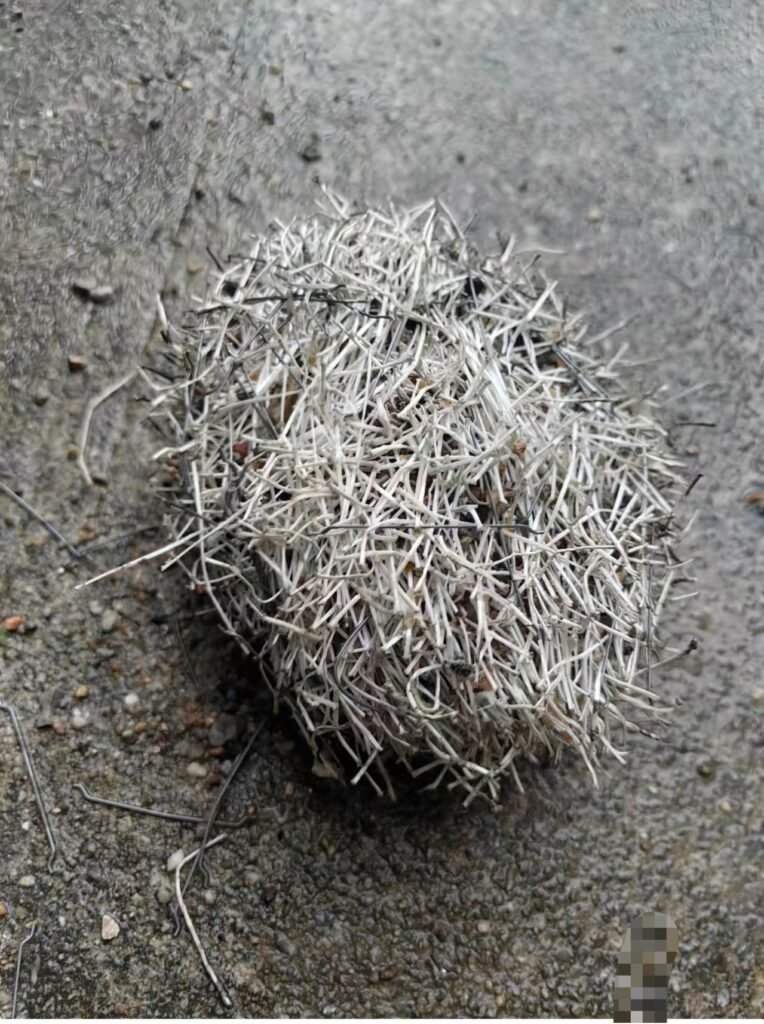
Analysis of Macro Synthetic Fiber Balling in Concrete: Causes from Fiber, Mix Design, and Construction Process
ConChip Concrete Fiber — April 2026
This photo was sent by a customer showing obvious "balling" (clumping) of macro synthetic fibers in concrete. While fiber balling does not usually affect the final structural performance, it reduces fiber dispersion uniformity and can compromise crack control effectiveness.
"Customer site photo of macro synthetic fiber balling"Below, we analyze the causes of fiber balling from three key aspects — fiber itself, concrete mix design, and construction process — based on industry experience and real test data.
1. Causes Related to the Fiber Itself
- Excessive fiber length and aspect ratio: Longer fibers (50mm and above), such as Twist Wave 50, are more prone to intertwining during mixing.
- Insufficient surface treatment: Standard fibers with poor hydrophilicity have difficulty being fully coated by cement paste.
- Fiber geometry: Wave-shaped or bundled fibers can easily form balls if not well dispersed.
- Poor packaging and handling: Fibers already slightly clumped before mixing.
ConChip® Advantage: Twist Wave 50 and Multi-Strand 58 use polar molecular modification to improve hydrophilicity and dispersion, greatly reducing balling caused by the fiber itself.
2. Causes Related to Concrete Mix Design
- Too dry mix (low slump): Slump below 80mm prevents proper fiber coating.
- Insufficient paste volume: Low sand ratio or cementitious materials.
- Aggregate gradation issues: Coarse or discontinuous grading traps fibers.
3. Causes Related to Construction Process
- Incorrect dosing sequence: Adding fibers too early or all at once into dry materials.
- Insufficient mixing time: Less than 4–5 minutes or fewer than 70 revolutions.
- Too rapid fiber addition: Dumping large quantities too quickly.
1. Use hydrophilic modified fibers like ConChip® series.
2. Keep slump between 120–180mm.
3. Dosing sequence: Aggregates → Cement → Water + Admixtures → Fibers (slowly).
4. Mix at least 4–5 minutes.
5. Always do a trial mix first.
If you encounter similar fiber balling issues, please send us the site photos, concrete mix design, and mixing details. The ConChip technical team can provide targeted solutions.
Contact us: https://conchip.net