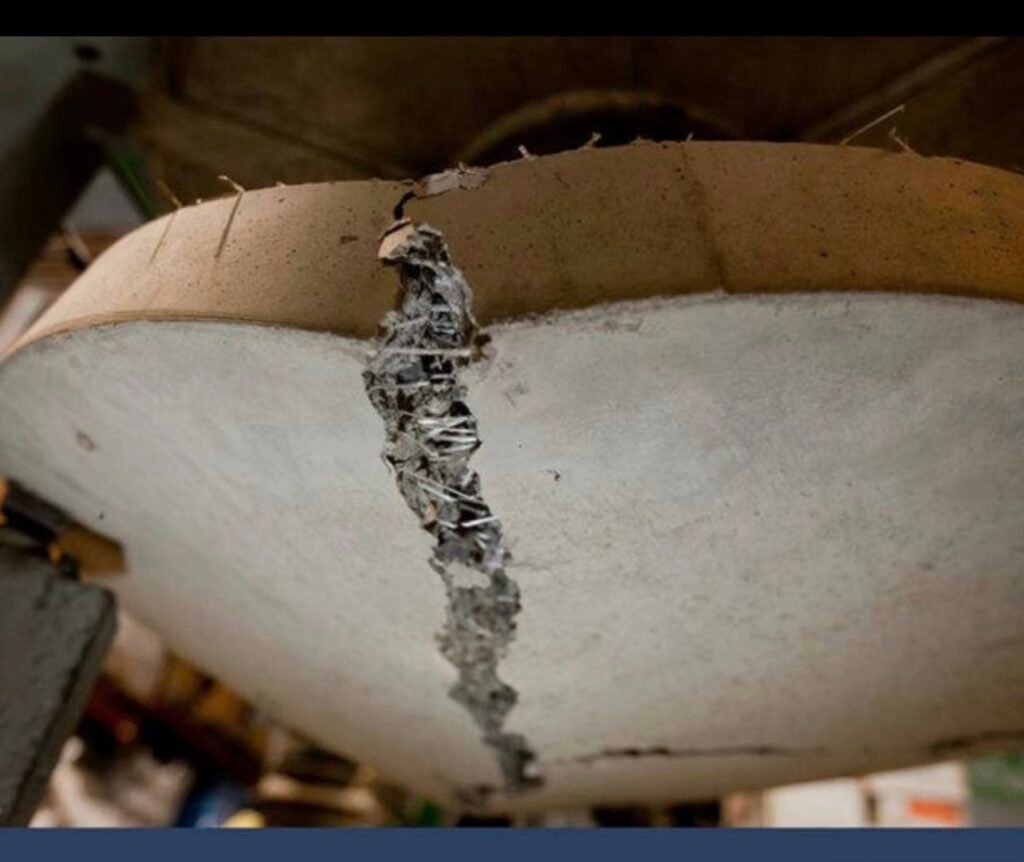
Concrete Beam Crack Resistance Test Standards and Real Data: Application Guide of Macro Synthetic Fibers in Industrial Flooring
ConChip Concrete Fiber — April 1, 2026
The crack resistance performance of macro synthetic fibers in concrete structures is mainly evaluated through flexural beam tests. These test data directly guide the design of industrial flooring, warehouse slabs, precast elements, and other practical engineering projects.
Below, we use international mainstream standards and real test data to clearly explain how beam tests are conducted, what the data mean, and how they are applied in industrial flooring projects.
1. Main International Standards for Concrete Beam Crack Resistance Tests
- ASTM C1609 / C1609M (Standard Test Method for Flexural Performance of Fiber-Reinforced Concrete)
This is currently the most authoritative method for evaluating the flexural performance of Fiber-Reinforced Concrete (FRC).
Specimen size: Typically 150×150×500 mm or 100×100×350 mm beams
Loading method: Third-point loading
Key indicators: First-peak strength, residual strength (f150, f600), and toughness (post-crack energy absorption) - ASTM C1399 (Average Residual Strength - ARS Test)
Focuses on measuring the average residual strength carried by fibers after cracking (in psi or MPa). - EN 14651 (European Standard, CMOD Test)
Measures residual flexural tensile strength (fR1, fR2, etc.) through crack mouth opening displacement.
Chinese relevant standards: GB/T 50081 and CECS 13:2009 can be referenced, but international projects mostly use ASTM C1609 as the benchmark.
2. Real Beam Test Data of Macro Synthetic Fibers (ASTM C1609 & C1399)
The following data are from real laboratory results of more than 500 beam tests:
| Dosage (lbs/yd³) | 3000 psi | 4000 psi | 5000 psi | 6000 psi |
|---|---|---|---|---|
| 4.0 | 150 | 175 | 200 | 220 |
| 5.0 | 195 | 215 | 240 | 250 |
| 6.0 | 230 | 250 | 275 | 285 |
| 7.0 | 260 | 280 | 300 | 320 |
Key Conclusion: Macro synthetic fibers can still provide significant residual strength after cracking, effectively controlling crack width and propagation. Residual strength increases with higher dosage and can significantly reduce early shrinkage cracks and load cracks in industrial flooring.
3. How These Data Apply to Industrial Flooring (Ground Slabs)
The core issues in industrial flooring are shrinkage cracks and load cracks. Beam test data can be directly used for flooring design:
- Adding 0.3%~0.5% volume fraction of macro synthetic fibers can reduce crack width in flooring by 70%~84%.
- Cracking load increases by 25%~44%, and ultimate load increases by 29%~69%.
- Significantly improves load transfer efficiency (LTE) and extends the service life of the floor.
Recommended Dosage: For industrial flooring with thickness of 15~20 cm, macro synthetic fiber dosage of 3~6 kg/m³ (approx. 5~10 lbs/yd³) is recommended, combined with ACI 360R Guide to Design of Slabs-on-Ground for calculation.
4. Twist Wave 50 vs Multi-Strand 58 Selection Guide
In practical engineering, Twist Wave 50 and Multi-Strand 58 are two of the most popular high-performance macro synthetic fibers in the ConChip® series. Both use polypropylene + polyethylene blend materials, with tensile strength ≥600 MPa and elastic modulus ≥11 GPa, offering excellent corrosion resistance. However, their design concepts and application scenarios differ.
| Item | Twist Wave 50 | Multi-Strand 58 |
|---|---|---|
| Length | 50 mm | 58 mm |
| Design Feature | Patented wave-shaped profile, strong mechanical anchorage | Four-strand bundle design, disperses into thousands of fine fibers after mixing |
| Tensile Strength | ≥600 MPa | ≥600 MPa |
| Elastic Modulus | ≥11 GPa | ≥11 GPa |
| Key Advantages | High energy absorption and strong anchorage | Extremely high fiber count and excellent surface smoothness |
| Recommended Applications | Tunnel shotcrete, slope support, precast elements | Industrial flooring, warehouse slabs, logistics centers |
Twist Wave 50 — Ideal for high-demand structural reinforcement
Its patented wave-shaped design provides strong mechanical anchorage and excellent residual strength in ASTM C1609 beam tests. It is particularly suitable for tunnel linings, mining support, and mass concrete where high toughness and impact resistance are required.
Multi-Strand 58 — Preferred choice for industrial flooring
The four-strand structure automatically disperses into a large number of fine fibers during mixing, effectively solving the problem of fiber protrusion on the surface. It provides uniform crack control and is ideal for projects with high requirements for surface quality.
• For industrial flooring projects, Multi-Strand 58 is recommended first (dosage 3–6 kg/m³).
• For tunnel or structural reinforcement projects, Twist Wave 50 is recommended first.
• In complex projects, the two can also be used together for complementary advantages.
Both fibers adopt polar molecular modification technology, achieving superior hydrophilicity and dispersion. They perform excellently in both beam tests and actual flooring applications.
Need precise dosage recommendations or test reports for your specific project (floor thickness, load class, environmental conditions, etc.)? Please visit https://conchip.net to contact us for technical support.
References
- ASTM C1609 / C1609M-19 Standard Test Method for Flexural Performance of Fiber-Reinforced Concrete
- ASTM C1399 Standard Test Method for Obtaining Average Residual-Strength of Fiber-Reinforced Concrete
- ConChip® Official Product Technical Specifications (Twist Wave 50 & Multi-Strand 58)
- ACI 360R-10 Guide to Design of Slabs-on-Ground
- Summary of real beam test data from multiple laboratories